Uprising
Cops and Robbers
[THE MAIN EVENT]
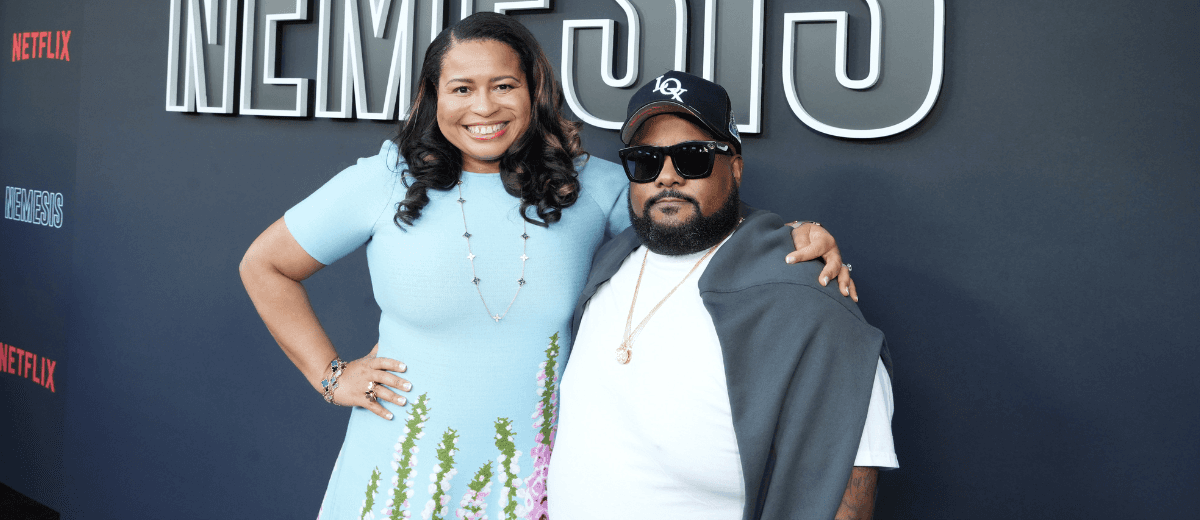
Nemesis co-creators Courtney Kemp and Tani Marole blur the lines between cop and criminal in Netflix's latest hit drama.
—————
UpRising: After spending years building the Power franchise, what felt important to do differently when you started working on Nemesis?
Courtney Kemp: Well, Nemesis is Tani and I together, so it's so diferent in terms of genesis and writing about both marriage and crime. Obviously, Power has something to do with marriage, but it has a lot more to do with adultery. [Laughs] I think I've changed as a writer. This show is much more optimistic, sunshiny, and hopeful. A lot of that has to do with Tani and how he approaches storytelling, as opposed to my commitment to unrelenting grimness. Power, the original series, certainly doesn't have a happy ending. Not that [Nemesis] is a happy ending, but this is definitely a much more optimistic place to end.
Tani Marole: Courtney and I are also engaged, to be transparent. I was a fan, a friend, a lover, and then a collaborator, in that order. As a fan, I'm always looking at what was so amazing about [Power] and I'm like, “You can't replicate that.” N.W.A can't remake Straight Outta Compton. But we can make another thing that carries on [Power’s] legacy and tradition and is completely different, yet cut from the same cloth. With Nemesis, we’ve moved across the country and [ramped up] the action.
I really enjoyed watching as the line between hero and villain—detective Isaiah Stiles (Matthew Law) and businessman/criminal Coltrane Wilder (Y’lan Noel)—becomes thinner and thinner. Do you see them as reflections of each other?
Tani Marole: When you look at the trope of the cop and robber, they’re always opposite sides of the same coin—at least the really good ones. Heat. The Untouchables’ Capone and Elliot Ness. Those are two sides of the same coin. They were both obsessed with their family. They had morals. But one carried the law, and one didn't give a fuck about the law. One gave arousing speeches, the other one gave a speech with a baseball bat.
When we looked at Stiles and Coltrane, we realized these men were opposite sides of the coin to the point that they both were family men. But the irony is that one has a family but is so obsessed with the other, while the other doesn't really have a family in terms of a kid, but wants a child. He’s so obsessed with the other that he can’t focus on that. Courtney really excavated all that.
Courtney Kemp: We definitely created them to be in some ways exactly what you would not expect. Our criminal is a gentleman and a really good husband. I know there will be a lot of comparisons between Coltrane and [Power’s] Ghost. The way I look at it is Coltrane is actually very black-and-white morally. He's very clean about the decisions that he makes. He's a loving person. He's very loyal to his friends and his family. That is not Ghost at all. Ghost is a very complicated person morally. I mean, Coltrane kills people—I'm involved, so there's going to be guns. But he is very, very moral in many ways.
Stiles believes in right and wrong, but it's his right and wrong. He's always whipping out a roll of money to bribe people. He's up to no good all the time. He just happens to have a badge. We really liked the idea of the white hat being morally gray and the black hat being morally clean. Those things were really important to us.
Sounds like morality was a major theme.
Courtney Kemp: I'm talking about moral code; Tani's like, "Listen, I want the cop who's fucking out of his mind, who’s doing too much, and is all over the place.” I love that idea, but I also really love when you're writing their dialogue that Coltrane's always making definitive statements about where he stands, and those turn out to be true. Whereas Styles is always saying some bullshit like, "I'm a man of my word," and then doing exactly the fucking opposite. He [tells his son], "I'm going to be at your next game." And he is at the game, but he's not paying attention. He's running out in the fucking parking lot chasing these dudes, and he's not even there to see his son hit the winning shot. That's what we were really trying to get into.
Who do you think is the real villain of Nemesis?
Tani Marole: High-vibration self [answer]: The enemy is everybody, internally. They're their worst enemy, and that's what your therapist will tell you. You're in your own way. Part of the work that I was doing as a human before I met Courtney was getting out of my own way. Coltrane and Stiles can't get out of their own way. Some of the peripheral people, their faults are following these motherfuckers that can't get out of their own way. But the ultimate villain is thyself.
My dirty section of YouTube [answer]: Malik, for sure, is the villain. But in Malik's defense, he doesn't wreck homes. He just looks at the ones that are wrecked, and he strips them for copper.
As a creator, how do you balance telling a contained story with Nemesis, while also building a world that could easily support multiple seasons?
Courtney Kemp: I don't make shows with the idea of not creating a universe at this point. There are little pockets in this framework for places that we can offshoot within the storytelling and the creation of this world. From the beginning, Power was contemporary New York—very committed to it. You have Dominican slang and Puerto Rican slang. You want to make everybody feel like they're real. Same thing here. We have our Samoan cop. We're trying to see Los Angeles as it is. We also really want to have a story that feels satisfying, but also like you can't wait to get the next season. We definitely wanted you to feel like you know these characters in eight hours. You know what they’re going to do, but at the same time, the storytelling itself is yanking you around and making you go, "I don't know what they're going to do to me next!" I used to call them “'Oh shit' moments.” I want the audience yelling at the screen.
—John Kennedy
----------
Nemesis stars Matthew Law, Ylan Noel, Cleopatra Coleman, and Gabrielle Dennis. You can stream the series Netflix now.
[IN CASE YOU WERE WONDERING]
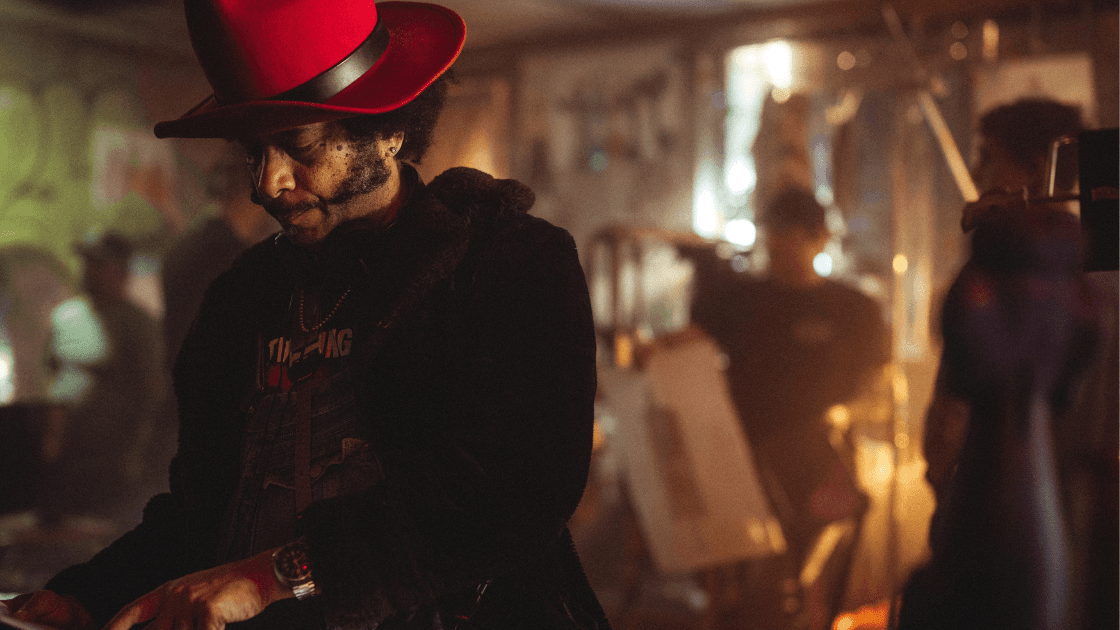
Director Boots Riley and LaKeith Stanfield want you to rethink how you judge the art of boosting after watching I Love Boosters.
—————
UpRising: It's been eight years since you worked together on Sorry to Bother You. You two were both at very different points in your film careers. What felt familiar about collaborating on I Love Boosters and what felt different?
LaKeith Stanfield: Boots is the same person, just more experienced and on the cusp of a new endeavor. So it feels like we're jumping off a new cliff. And I mean that in the most beautiful and exhilarating way. I know we're doing something meaningful and fun, and we're going to see if this thing works. That part feels the same. It felt different in terms of scope [compared to] the last time we worked together. Now, we’ve got a little bit more elbow room. We can move around. We have this great cast, these wonderful costumes, and set designs that are really intricate. It just felt like the breadth of filmmaking was all there. So things felt evolved, while the spirit of Boots’ creativity remained constant. I knew this would be super special, and I felt happy to be a part of it.
Boots Riley: That holds it up. LaKeith has definitely become… I don't know if I want to say more sure of himself, but he knows what he wants. He knows how he wants to approach something. We talked about [I Love Boosters] a lot longer [than we talked about Sorry to Bother You]. This is a very, very different character, as well. As a matter of fact, he was around when he just had to be an extra. There’s one part that we added just because I was like, “Damn, I got him in here just being an extra.” The second-to-last time we see him talking was just added in. And it’s funny—people crack up at that part.
Boots, you made the song “I Love Boosters” 20 years ago as part of The Coup. Why did this moment and phase in your career feel like the right time to do this film and present your commentary on the fashion industry?
Boots Riley: I started writing this in late 2018 and finished it in 2021, right before we went into production on I’m a Virgo. So these ideas have been around. It speaks to a larger truth that happens to be very prescient right now. We're all thinking about art and fashion, because fashion is how a lot of people express themselves. Their expression might be, “This is how individual I am,” or “This is the tribe I'm in,” or “This is sexually what I'm into.” It may be all sorts of things. It's an art form, and we're all looking for ways to express ourselves and connect with other human beings.
Fashion gets presented to us as this thing that fashion houses create, but in reality, it's created and popularized by a lot of people. Boosters are folks who are being villainized as people hurting the world and society. People on Twitter are like, “Why are they glorifying boosters?” They would never say the same thing about Oceans 11. And the reason is that we've had an obfuscation of what is wrong with the world, where exploitation happens, and where oppression comes from. We've been sold this idea that poverty is the result of the bad choices of those who are impoverished, and not that it's built into this economic system. People boosting is necessitated by the system that we live in. Boosters are holding up a community whose style is inspiring fashion houses and being sold back this stuff at much higher prices than they can afford.
LaKeith Stanfield: If you think about it, you see in all these designer stores, the jeans ripped up with dirt on them, or tennis shoes that look like they got run over by six cars. That gets this pristine treatment; that seems like a symbol of what he's talking about. Reaping all the negative stuff. And you need a scapegoat. You always do, especially when you're talking about customer service or [salespeople]. You need something else to make it look like the thing that you’re doing ain't as bad. Unfortunately, in this country, when the skin is darker, you could just point to that and be like, “There goes the problem over there.”
Sorry to Bother You, I’m a Virgo, and I Love Boosters all lean into surrealism to communicate their points. Why has that become your preferred language as a storyteller?
Boots Riley: I don't necessarily set out [to do it]. I'm not committed to it. But it's what's working. Part of it is that I’m heightening contradictions, and that feels absurd. I want us to have an emotional response that's analogous at least to what the character is going through. In Sorry to Bother You, the overdubbed voice felt a little bit off and weird and wrong. That's similar to what the character might be experiencing, either by doing it or listening to it. And the heightening of that contradiction is often the thing that's thought of as absurd.
I would say it’s more absurd than surreal. If you talk about the capital-S surrealist, they're usually thinking about [Sigmund] Freud and dreams and stuff like that. The capital-A absurdists are also not what I'm doing, because they’re more nihilist. It's all ridiculous. I’m neither of those, but closer to absurdism.
It's effective in creating a visceral experience. The need for the visceral experience comes from my work in music. You can have raw-ass lyrics, and people are like, “What does the beat sound like?” They want to feel it in their body. I want to create cinema that does that. It's not even just absurd, crazy stuff. It might be the fact that if I play violins, you're going to know I'm saying [the character is] sad. But if I play music that's dissonant with that—maybe happy—you're going to think this is happening and it's different than that. I want you to engage with the film in a different way. I want the challenge of pushing you away and pulling you in at the same time.
—John Kennedy
—————
I Love Boosters stars Keke Palmer, Taylour Paige, Naomi Ackie, Eiza González, and LaKeith Stanfield. The film, which is written and directed by Boots Riley, hits theatres May 22.
[TAKEN OUT OF CONTEXT]
I find myself doing these serious roles, and people think I'm very serious. No one knows that I'm the second-funniest person that I know.
This actor is a man’s man—just look at a rundown of his biggest roles. But based on his on-screen work, you might not expect him to be a funnyman in real life. If you’re still wondering who it is, read about him in this Rolling Stone profile.
LET'S LINK
Vivica A. Fox Had to Remind Sterling K. Brown She's "Tough As Nails From Kill Bill" During Brutal Is God Is Scene [Entertainment Weekly]
Euphoria Star Colman Domingo Is Suddenly Everywhere. (It’s About Time.) [The Hollywood Reporter]
The House of the Spirits Is What Happens When Latinos Tell Their Own Stories [Remezcla]
Historically Black Colleges Take the Lead in Driving the Growth of Women’s Flag Football [Andscape]
[TRAILER PARK]
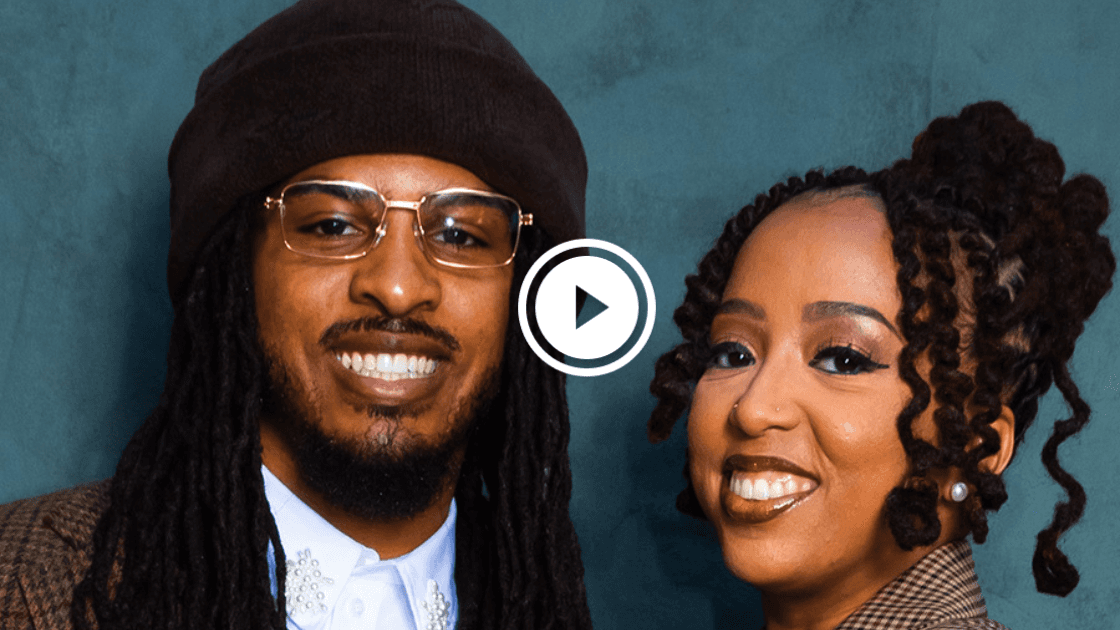
Watch the Trailer for Keith Lee's Docuseries, All in the Familee
Keith Lee has come a long way from reviewing restaurants around the country. The self-made food critic’s taste buds are some of the most trusted out there. Now, they’re helping him curate a festival of his own.
Keith Lee's Familee Day took place over the weekend in New Orleans, and the former wrestler is offering an inside look at the painstaking journey to bringing his first festival to fruition. All in the Familee is a four-part MACRO-produced docuseries that captures the weeks leading up to Familee Day, showing how Lee balances his family life and showcasing his favorite restaurants. Take a look; we’re sure you’ll rate it a 10.
[OUTRO]
Take This Audio Doggie Bag With You
“Cheetah Print,” Drake Featuring Sexyy Red
Last year, Drake insisted he was done with petty rivalries on “Gimme a Hug.” His three(!) new albums roll back that promise, but this future summer anthem is a vegan banger: No beef. A sample of Peggy Gou’s 2023 dance-pop track “[It Goes Like] Nanana” meets an interpolation of “Cha Cha Slide” to create something irresistible.