Uprising
Ricky Is an Emotional Look at Life After Prison
[THE MAIN EVENT]
UpRising: Why was Ricky an important story for you to tell?
Rashad Frett: Lin Que and I went to NYU together, grad film school. Lin Que finished her thesis and graduated a year before me.
Lin Que Ayoung: We were supposed to graduate together, and then [the pandemic] happened. That held up his thesis.
Rashad Frett: That was a blessing in disguise, because that hold-up is the reason we're here. I was going to graduate with a script for a short film based on my life. Lin Que was like, “Why not just make another short?” Lin Que and I tend to pull from life experiences when we make stories. With Ricky, I’ve never been incarcerated, but a lot of cats around me were. Family members got deported to the Caribbean. They’d do 10 or 15 years, come out, and immigration would pick them up. I saw a lot of that growing up. Lin Que did, too.
I did a documentary on the criminal justice system, so I saw how inmates try to reacclimate into society. Even some of my peers—they were still stuck in the ’90s years later. I wanted to capture that in a story. That was the genesis.
Lin Que Ayoung: My first boyfriend’s brother was incarcerated. There was a lot of trauma in the house. I got to see what that life was like. I got to know who he was. So I was interested in this storyline of getting underneath [stigmas] about ex-offenders. I wanted to show the humanity and show that there are ex-offenders who want to be a great example, to have an opportunity to show he's grown. A lot of people don't get that opportunity.
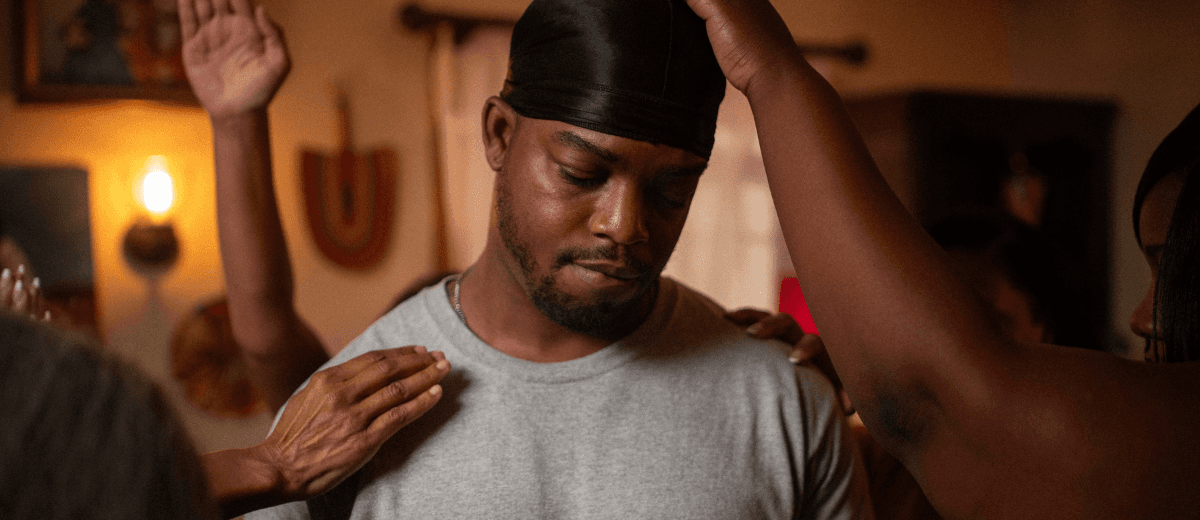
The film’s artwork shows Ricky (Stephan James) looking down, with several sets of hands embracing him. What does that symbolize?
Rashad Frett: This is stuff I've seen firsthand growing up, going to church. There were times when church members had children or family who were having a tough time and were convinced to come to church and get that blessing. Those hands represent that. Ricky isn't alone. He isn't the only person going through it.
Lin Que Ayoung: It's so important that we recognize the families that are dealing with this, the families that are doing time in their homes while their loved one is in prison. It takes a village; it's not just about the person in prison. A lot of it has to do with the women supporting Ricky: his mother, his godmother, Bernetta, who lives next door. We wanted to make sure his story was multi-dimensional and show how it affects the people who love him and the community.
The storyline shows the structural and systemic challenges that Ricky faces, and that is tough to watch. But you also see examples of self-sabotage. Can you talk about the significance of hitting that balance?
Rashad Frett: So Ricky is a combination of numerous people that we knew jammed into one person. We wanted to make it feel as real as possible. There are highs and lows. And a majority of the stuff you see in the film actually occurred. Lin Que and I would be talking for hours about people we knew or things we’ve seen.
Lin Que Ayoung: We spoke about how important it was not to create some type of scenario where he's victimized. No, this is about second chances. It’s about somebody who got in trouble at 15, made a mistake because he was kicked out of his home, and had to suffer the repercussions. This is what happens to a person whose growth is stunted in the penal system.
Ricky’s journey is also about accountability. He makes a pivotal decision in the film that is a subtle callback to the situation that initially landed him in prison. He attempts to break the cycle.
Rashad Frett: Accountability is one of the main themes that we wanted to focus on with this film. Sometimes things happen because people don't wanna be accountable, and that causes much bigger issues to occur. I see cats on the street that go through it. That was one of the main things we wanted to touch on, alongside family and brotherhood.
Lin Que Ayoung: It transcends just ex-offenders. Human beings need to be accountable. Especially in today's climate. People need to own up to things they're doing.
Ricky is set in Rashad’s hometown, Hartford, Connecticut. But you could imagine this story taking place in any low-income neighborhood. Are there ways that Hartford is a character in this movie?
Rashad Frett: I wanted it to be a backdrop, but I didn't want it to be, “This is Hartford.” You know what I mean? I just wanted it to be the stage that I knew. There’s a huge Caribbean community, so I wanted to capture that aspect as well.
Have you thought about how this story about detention and incarceration may resonate in the era of ICE and harsh deportation policies? Does it hit different than when you first started working on Ricky years ago?
Lin Que Ayoung: When it comes to films, context is so important. Certain films hit different depending on what's going on in the world. What was ironic is when we first started developing Ricky, and we're talking about his dad, [he wasn’t] the deadbeat dad; he was deported. That was a very conscious decision. It definitely hits different in 2026. It's very relevant right now. People who didn't understand deportation have a better understanding of it now. And it transcends the Caribbean community.
Rashad Frett: To my amazement, people from all over the world have been hitting me up, like, “Wow, this is my story.” They love to film out in Brazil. Australia. At Sundance in Utah. And not just people of color. People from all walks of life. It's deep.
You can see that universal impact during the end credits, when viewers see interviews with real-life ex-offenders or people who have been exonerated. It’s not just impacting our folks.
Lin Que Ayoung: I was very happy that Rashad chose people from different backgrounds and chose a woman, particularly a woman who is in school now, to understand what she's been through. This movie is supposed to transcend all of that and just [tell] a human story as opposed to a Black man’s story.
Did those conversations with ex-offenders shape the movie in any way?
Rashad Frett: It just made it that much more personable. I did documentaries for many years. It affects my cinema style and how I approach this film. I wanted it to feel like a borderline documentary. But it was important to actually hear from ex-offenders. There were many, many more that we interviewed. Unfortunately, we weren't able to include everybody. This film is just a tool to start much-needed conversations on inequalities in the criminal justice system. Things are getting better; there are a lot of programs out there. But there’s still a long way to go.
—John Kennedy
—————
Ricky stars Stephan James, Sheryl Lee Ralph, Imani Lewis, and Andrene Ward-Hammond. Check out the self-distributed film on its April 24 nationwide theatrical release, with facilitation by Blue Harbor Entertainment and in partnership with Spark Features.
Photo Credit: Sarah McColgan
[VERSUS]
Battle of the Beasts
Adewale Akinnuoye‑Agbaje reveals which role brings him the most joy: Oz’s Emerald City emperor Adebisi or Euphoria’s sharp‑shooting, pimp‑styled cowboy, Alamo Brown.
—————
"I really enjoy playing Alamo [Brown]. There's a maturity to him, which I obviously have inhabited, because it's 30 years after playing Adebisi. But one of the things about Adebisi is that I was fearless. I was a young actor, and I think it's some of the better work I've done in my career. It's responsible for many of the roles that I've gotten. People have hired me because of that. Lost wrote [the character] Mr. Echo based on [Adabesi and Oz]. I did The Mummy Returns and The Bourne Identity all because of that performance.
Alamo is the right guy to be playing now. And I love the fact that he's American, because it took me many years to convince the industry that I could play American roles. So to play a Texas cowboy with that same kind of fearless swag as Adabisi is full circle. And that it happened to be Sam Levinson — I worked with his dad, Barry Levinson, on Oz — is a mystical full circle. The apple didn't fall far from the tree. They have the same fearless sensibilities and creative pioneering spirit."—As told to Jermaine Hall
——————
Catch Akinnuoye-Agbaje Sunday night in the second episode of Euphoria's third season.
[TAKEN OUT OF CONTEXT]
"Here’s my biggest thing about dating. People talk too much. I need them to shut up. If we’re going to have a one-night stand, I almost feel like I need to have them sign NDAs."
This iconic actress has been one of Hollywood’s most desired for decades. Turns out, her dating life is going about as well as ours. Tap in to see who it is, then catch up on the anticipated film she has en route.
[LET'S LINK]
Inside Saudi Arabia’s Billion-Dollar Bet on Hollywood [The Hollywood Reporter]
Who, Exactly, Still Likes Ye? [The New York Times]
The TV News Industry Is in Trouble. How Telemundo Is Defying the Odds [The Los Angeles Times]
Patina Miller Brings Major Drama to Her Manhattan Townhouse [Architectural Digest]
When Male Brazilian Rappers Went Corporate, Women Took Over the Genre [Remezcla]
Space Launches $3K Dorm Decor Grant for HBCU Freshmen [Level]
Mamba Out: 14 Never-Before-Told Stories from Kobe Bryant's Farewell Tour [Complex]
[OUTRO]
Take This Audio Doggie Bag With You
“Rackies,” Sexyy Red Feat. ATL Jacob
It's been two decades since D4L had the whole world snapping fingers to “Laffy Taffy.” Now, Sexyy Red revives that 2005 classic by sampling it for a standout from her new project, Yo Favorite Trappa Favorite Rappa.